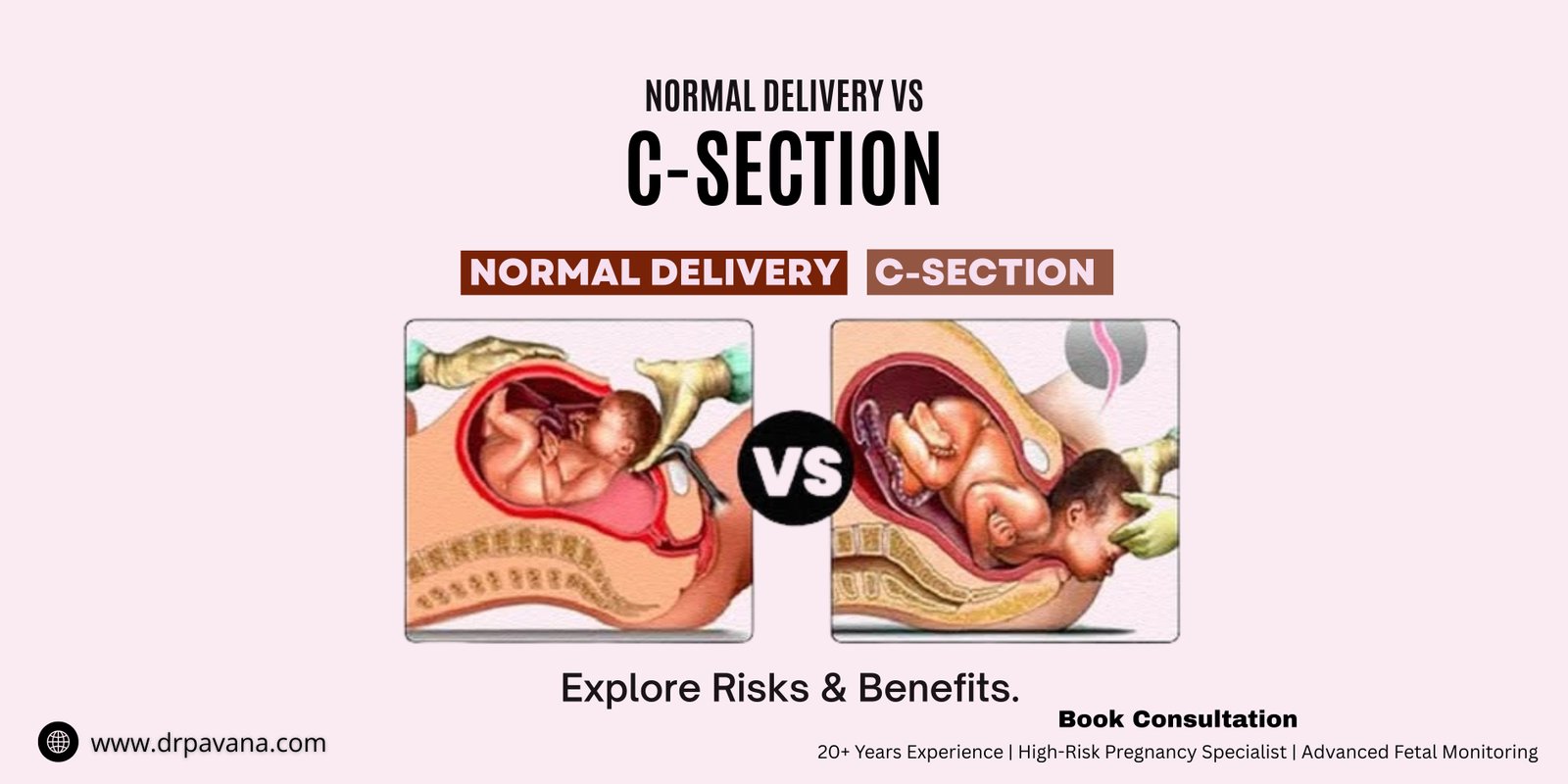
Normal Delivery vs C‑Section in Noida: How Do Gynecologists Decide What Is Safest? – Dr Pavana H.N.
Many pregnant women in Noida worry about whether they will have a normal delivery or a C‑section, and which is actually safer for them and their baby. Understanding normal delivery vs C‑section helps you ask better questions and feel more confident when you discuss your birth plan with your gynecologist in Noida. Gynecologist and obstetrician Dr Pavana H.N., practising in Noida and Greater Noida West, explains how doctors decide the safest mode of delivery based on medical guidelines, your health and your baby’s condition.
What is a normal delivery and what is a C‑section?
A normal delivery (vaginal birth) means the baby is born through the birth canal, usually after spontaneous or induced labour. For most healthy women with low‑risk pregnancies, a plan for vaginal delivery is considered safe and is generally recommended by international guidelines. A C‑section (cesarean section) is a surgery in which the baby is delivered through cuts on the abdomen and uterus under regional or general anesthesia. It can be life‑saving when there are complications that make normal delivery unsafe, such as severe bleeding, placenta problems or serious concerns about the baby’s heart rate.
When you compare normal delivery vs C‑section, it is important to remember that one is not “good” and the other “bad” in all situations. Your gynecologist in Noida looks at your individual risk factors, pregnancy progress and baby’s well‑being before recommending what is safest in your case.
When is normal delivery usually preferred in Noida?
For low‑risk pregnancies, gynecologists generally encourage normal delivery because it has:
Normal delivery is often preferred when:
Mother and baby are healthy and pregnancy is low risk.
Baby’s head is down and fits well into the pelvis.
There is no placenta previa (placenta covering the mouth of the uterus) or major bleeding.
There is no serious uncontrolled medical condition like severe heart disease.
For these women, normal delivery usually means shorter hospital stay, quicker recovery, earlier breastfeeding and lower chances of some surgical risks like infection or heavy blood loss. In India and globally, expert bodies like ACOG recommend that if there is no clear medical reason for C‑section, a vaginal birth plan should be discussed and offered.
When do gynecologists recommend C‑section instead of normal delivery?
Sometimes the C‑section becomes the safer choice for mother or baby. Gynecologists may advise C‑section when there is:
Fetal distress: Baby’s heart rate pattern suggests the baby is not tolerating labour well.
Abnormal position: Baby is breech (feet or bottom down) or lying sideways, and turning the baby is not possible or safe.
Placenta problems: Placenta previa or placental abruption (placenta separating early) causing bleeding.
Very large baby with small pelvis (cephalo‑pelvic disproportion): Labour is unlikely to progress safely.
Previous C‑section with high risk of scar rupture: Especially with a classical scar or multiple previous C‑sections.
Multiple pregnancy with complications: Such as certain twin positions or growth problems.
Maternal health issues: Severe pre‑eclampsia, some heart or eye conditions, or active genital infections.
In these situations, insisting on a normal delivery can be risky. When comparing normal delivery vs C‑section in such high‑risk cases, your gynecologist in Noida will usually recommend C‑section because it offers better safety margins for you and your baby.
How do gynecologists in Noida decide what is safest for you?
Doctors do not decide between normal delivery vs C‑section based on one factor alone. Gynecologists like Dr Pavana H.N. look at:
Your medical history (age, previous surgeries, existing illnesses).
Your obstetric history (previous normal delivery, previous C‑section, miscarriages).
Current pregnancy details (baby’s position, placenta location, amniotic fluid, growth).
Labour progress (cervix dilation, contraction strength, baby’s descent).
Fetal monitoring (baby’s heart rate on CTG).
They also consider your preferences, fears and previous birth experiences. For example, if you have had a C‑section before, Dr Pavana will discuss the option of trial of labour after cesarean (TOLAC) versus elective repeat C‑section, based on your scar type, hospital facilities and current pregnancy risk. This shared decision‑making process is a key part of safe obstetrics and respects your role in choosing what feels right for you within medical safety limits.
Pros and cons of normal delivery vs C‑section
When you think about normal delivery vs C‑section, it helps to compare realistic advantages and disadvantages instead of myths.
Normal delivery may offer:
Shorter hospital stay and faster return to routine activities.
Lower risk of certain surgical complications, such as wound infection or blood clots.
Better early breastfeeding and skin‑to‑skin contact rates in many settings.
But normal delivery may also involve:
Longer duration and unpredictable timing of labour.
Possibility of perineal tears or need for instruments (forceps or vacuum).
Unplanned emergency C‑section if labour does not progress or baby shows distress.
C‑section may offer:
Planned timing, which can reduce anxiety for some families.
Shorter time from decision to birth in emergencies.
But C‑section also carries:
Higher rates of newborn NICU admission and maternal ICU admission in some studies.
Increased risk of respiratory issues in babies if done before 39 weeks without clear need.
Longer recovery, more pain in the first days, and higher costs.
Higher risk of placenta problems and uterine scar issues in future pregnancies.
Your gynecologist’s goal is to choose the mode of delivery where the benefits are higher and the risks are lower for your specific situation, not simply to push for one option for all women.
Can you choose the C‑section even if normal delivery is possible?
Some women request C‑section because they fear labour pain or are worried about pelvic floor damage. Guidelines suggest that when there is no medical need, doctors should first address these fears by offering good pain relief options (like epidural), childbirth education and emotional support. If, after counselling, you still strongly prefer C‑section, your gynecologist will weigh your request against the potential short‑ and long‑term risks for you and your baby.
At her clinics in Noida and Greater Noida West, Dr Pavana H.N. explains options honestly and encourages you to ask questions non‑judgementally, so your final decision is informed and aligned with medical safety.
How does Dr Pavana help you decide in Noida?
As a gynecologist and obstetrician practising in Noida and Greater Noida West, Dr Pavana H.N. uses evidence‑based guidelines and her clinical experience to guide you through the normal delivery vs C‑section decision. She:
Reviews your history and current pregnancy in detail.
Explains your individual risk factors in simple terms.
Discusses likely scenarios in labour and when plans might need to change.
Answers your questions about pain relief, scars, recovery and future pregnancies.
Her aim is to balance safety with your comfort and preferences rather than forcing a particular mode of delivery.
Frequently asked questions – Normal delivery vs C‑section in Noida
1. Is normal delivery always safer than a C‑section?
No. For low‑risk pregnancies, normal delivery is usually recommended and safe, but in high‑risk cases like placenta previa, severe fetal distress or some previous scars, C‑section can be safer for mother and baby.
2. Can I have a normal delivery after a previous C‑section?
Many women can try for a vaginal birth after cesarean (VBAC) if they have a low‑transverse scar, no major complications and deliver in a hospital prepared for emergency C‑section, but the decision must be individualised with your gynecologist.
3. Does a planned C‑section avoid all labour pain?
A planned C‑section avoids labour pain but involves surgical pain and recovery. Modern labour pain relief (like epidural) can also make vaginal birth much more comfortable, so discuss all options with your doctor.
4. Which is better for my baby’s health in the long term?
Research suggests that when medically appropriate, vaginal birth is associated with fewer short‑term complications and may have some advantages for baby’s immunity, but when C‑section is clearly indicated, it can be life‑saving.
Recent Blogs






Categories

Dedicated to compassionate, expert women’s healthcare, we support every stage of life with personalized gynecological and obstetric services.
Quick Links
Get In Touch
Clinic 1- The Derma & Gynae Clinic
A-59, Block-A Sector-41, Noida
(Near Sector-41, Market)
Contact No.: 7982301616
Clinic 2- Truecare Clinic
UGF -11 Saviour Green Arch Market Near Ek Murti Chowk, Noida Extention
Contact No.: 9582525020
All Rights Reserved.